
Publié le 4 mai 2026 · 6 min read
For this week’s MVP, we’re chatting with Carlene Higgins.
It’s no secret that Canadian beauty brands have a long history of challenging the status quo. From MAC Cosmetics to Deciem—the company behind The Ordinary—these homegrown businesses haven’t just sold beauty—they’ve reshaped how we think about it. That same spirit of disruption is something Carlene Higgins knows all too well. After her tenure as a beauty editor at the now defunct Flare magazine, she co-founded the Breaking Beauty podcast, which has been running for nearly a decade and now has over 440 episodes. She’s interviewed everyone from Hailey Bieber to Bobbi Brown—until she felt ready to step beyond storytelling and into creation.
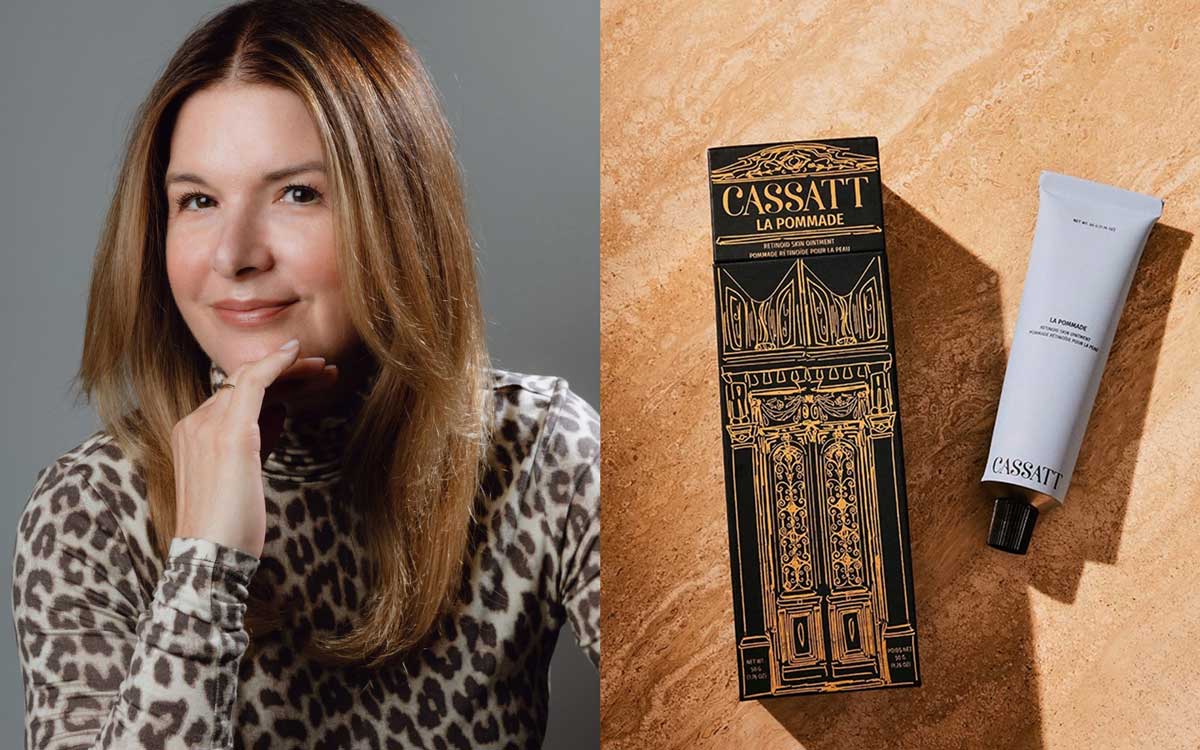
On the cusp of turning 50, she launched Cassatt Beauty. Starting with a single product—a retinoid ointment called La Pommade—the brand pushes back against the youth-centric ideals that dominate industry marketing. Instead, it embraces what Higgins calls “mid-life vibes” to celebrate lived experience over the unattainable pursuit of turning back the clock. Here, she opens up about pivoting her career, building a business on the side and navigating the financial realities of bringing it to market.
Why did you pivot from creating so much content about the beauty industry to actually creating a company of your own?
When I left Flare magazine, I started two projects at the same time: the Breaking Beauty podcast and a website called Beholder, which was aimed at cool women over 40. I created it because there was nothing in the media landscape that reflected women like me and my friends in a modern, relevant way. I was inspired to create a space that reflected my real-life community—women who are stylish, are travellers and shoppers, and are living full lives—not just stereotypes focused on parenting, recipes or being “a boss lady”—whatever that means. There were beauty companies catering to the same cooler, more modern audience of women over 40. Brands were targeting that demographic, but the messaging felt outdated and disconnected, and when I walked into department stores, I saw that the models or celebrities used in campaigns were so young.
When naming the company, were you deliberately referencing the artist Mary Cassatt’s famous New Woman paintings?
The brand name was somewhat inspired by Mary, but not literally. It was really about the idea of a “female gaze” and women over 40 who embody intelligence, creativity and independence. I love the idea of making up a mythical woman who could encapsulate all of those qualities—someone who is smart, a feminist and cool. She goes out dancing a few times a year. She listens to house music. She travels to Paris. She is interested in art. I really appreciated that Mary Cassatt painted women in their homes and social circumstances—I thought that was a beautiful coincidence. I also thought of Cass Bird—my favourite photographer, known for creating a community of badass women—and the iconic Marchesa Casati [the early 20th-century Italian heiress and unconventionally beautiful muse for Jean Cocteau and Cecil Beaton].
What was your process like when it came to finding the funds to fuel Cassatt?
It is a startup, so I was able to get my first funding from Women’s Enterprise Organizations of Canada. It’s a program through the Canadian government that provides aid for female entrepreneurs. They forced me to be very diligent. You have to create a business plan for two years and really forecast exactly where your money is going. It took me one year to get the loan because they were so rigorous about where exactly my budget was going. I had to give them lists of all my manufacturers. So far, I’ve decided not to have any investors because I want to make sure my equity is protected. I invested immediately in a campaign because I have seen beauty brands launch without one—a situation where you just go to the website, see the product, but there’s no information behind it.
Obviously, this is my forte; coming from a beauty editorial background, I was able to create and communicate a clear vision. Skincare and cosmetics are such a saturated market, they require that storytelling aspect or you will just get drowned out.
What do you see as your biggest challenge?
With this demographic, what I’m really competing against are high-tech brands that are leaning on the longevity movement, using ingredients coming out of biotechnology—and there’s a lot of money there. Investors don’t necessarily know a lot about the beauty business, and I think they are easily swept away by these high-tech stories because there’s an affinity. But in my opinion, women gravitate towards storytelling. How many people can relate to a particular molecule and want to use that every day, making it part of their ritual, without feeling like they’re part of a community?
How has your management of money evolved, both personally and professionally, since the launch?
On the business side, I use Shopify and QuickBooks—I lean on both tools, and they are a big help. I’ve also learned to budget for less digital marketing. That is probably the biggest temptation. You’ll never see a thousand dollars get flushed down the toilet faster than when doing week-to-week digital marketing tests.
Personally, as a shopaholic till I die, I’ve had to learn how to make and follow a budget too. I’ve really embraced consignment shopping at places like Rewind Couture in Toronto and Common Sort. At these types of stores, I can sell my clothes, get credit, and buy other pieces in the same place. It’s very circular—it gives me that dopamine hit I’m craving while keeping my wardrobe refreshed and without buying new.
I also feel good knowing less clothing is going into landfill from my personal wardrobe. I’m transitioning my hair to blend in my greys, which is saving me a lot of money—I used to spend about $250 every four weeks, or up to $800 every third visit for full highlights.
People often say life moves in phases: In your 20s you learn, in your 30s you earn, and in your 50s you return. Does that ring true to you?
I feel that way. That’s one of the privileges of turning 50 and having this brand—it comes with a very mature mindset. I love owning that maturity and being able to make decisions where there’s an automatic kind of mentoring for those coming up next. There’s a caregiving aspect to what I do. We need to be responsible—or at least aware—of being good role models for younger generations. I feel that strongly.
Do you think the Canadian beauty market is misunderstood by global competitors?
I think we’re underestimated. That’s the challenge with being Canadian across many industries. However, I absolutely love being underestimated.
Read more from this issue of The Get:
Elio Iannacci
An award-winning writer, scholar and journalist, Elio Iannacci’s work has appeared in more than 80 publications, including The Globe and Mail, Vogue Italia, The Hollywood Reporter and Maclean’s. His writing also appears in a number of literary anthologies, including the newly released The Nuances of Love, published by Guernica.



The Get is owned by Neo Financial Technologies Inc. and the content it produces is for informational purposes only. Any views and opinions expressed are those of the individual authors or The Get editorial team and do not necessarily reflect the official policy or position of Neo Financial Technologies Inc. or any of its partners or affiliates.
Nothing in this newsletter is intended to constitute professional financial, legal, or tax advice, and should not be the sole source for making any financial decisions. Past performance is not a guarantee of future results. Neo Financial Technologies Inc. does not endorse any third-party views referenced in this content. Always do your due diligence before deciding what to do with your money.
© 2026 Neo Financial Technologies Inc. All rights reserved.