
Publié le 17 août 2026 · 5 min read
For this week’s MVP, we’re chatting with Craig Silverman.
Has the internet ever fooled you with a shark attacking a kayak? A toddler quoting Shakespeare? President Donald Trump chatting with Jesus? Sad but true: All but that last one may have—even if just for a minute—had this absentminded social scroller completely forgetting that Kapwing’s recent investigations found that so-called “AI slop” makes up at least 20% of video suggested to new users by YouTube’s algorithm (and more than half on TikTok). Spotting the difference between AI and IRL is getting more difficult with every passing day, but “fake news” experts, including this week’s MVP Craig Silverman, are stepping up to help gullible folks like me learn to recognize misinformation, media manipulation and digital deception.
De notre commanditaire


Here, the Toronto-based investigative journalist and co-founder of Indicator (and its trailblazing newsletter that you should subscribe to right now), tells The Get readers how to spot a deepfake in action.
What does Indicator do?
We investigate digital deception and train professionals on how to do it, too. Journalists, people working at digital platforms in trust and safety, basically anyone who’s a professional investigator or wants to be one would all benefit from Indicator.
The reality now is that tools generating synthetic media are getting really, really good. AI-generated content can and does look very convincing. We help people be more aware and learn to recognize the signs.
I admit I’m embarrassingly gullible. My brain assumes an image is proof of something real, and then, I wise up and feel like a complete dummy.
This is really not about intelligence or being too gullible. The natural, human tendency is to look with your eyes and believe what you see—unless something seems off.
Even just a year or two ago, you could rely a lot more on obvious observational clues: things that defy the laws of gravity or physics, a person speaking out of sync with their lips, or six fingers on a hand.
Today’s models and tools are widespread and evolving so quickly that you’re often not going to see a really telltale observational sign. So, step number one is just being aware of how good the fakes are now and to understand that it’s really not your fault for being convinced.
What’s step number two?
Just be patient and take a pause. You don’t need to get swept up right away, and it’s definitely not necessary to share something you see right away. Understand that there are a lot of convincing fakes out there, particularly ones that feature celebrities, politicians and high-profile figures.
We have to learn to stop and think more critically and say, OK, in this TikTok video, this person is saying this about this topic or product. If you think it’s worth sharing, first do just a little bit more research about the person or product or information.
The bottom line is we have to make a better effort.
How do I actually do that though?
You can look elsewhere for additional information from sources you know and trust. You can find out what’s been subject to a fact-check. Do a quick reverse image search using Google Lens or TinEye to see if a photo or video has been the subject of a fact-check or if concerns have been raised about it.
It’s basically a search based on a still photo to give you some context. If you choose to pass it along, maybe say something like, “I saw this but I’m not sure about it.” This gets other people thinking too, and maybe they can help, but ultimately we need to start engaging more skeptically, with awareness and patience.
Ugh. I thought AI was supposed to make our lives easier?
It’s making certain things easier for certain parts of our lives, but it also creates a lot of complications and difficulties. It’s enabling scammers and fraudsters and agents of disinformation to massively scale up and make their efforts more efficient. Like anything else, we don’t only get the good side of AI.
I sent someone an email recently and they wrote back asking me to “prove” I was a human. What the heck?
It’s so tricky because even a live video call can be doctored. A deepfake can pretend to be somebody else. Society is not really equipped, and we need to figure out how to reestablish trust in an information environment where it’s very easy to create very convincing fakes, whether it’s images, audio or video.
There are some technical things, like a photo might have metadata attached to it with useful information, and there are automated tools that you can run photos, videos and text through that can give you indications of whether something might be synthetically generated.
But because technology evolves so quickly, the manipulators and the generators are far more advanced than the detection tools. It’s the classic cat-and-mouse game where some technical tools can be helpful—but you can’t rely on them 100% of the time.
What can we rely on instead?
Ironically, it’s the very manual old-school work and human thought that technology cannot replace. Who’s the person in this photo? Where is this place? When was the photo supposedly taken? Can I establish through any other means whether this person was ever there? Who took this photo or video? Can we talk to them?
This is a lot of work. While the person generating the fake face could be doing it in seconds or minutes, the person verifying and determining whether it’s real or fake could take hours or days.
That’s what we do at Indicator. And you don’t have to know how, but if you’re interacting with these AI systems on a daily basis—which most of us are, whether we know it or not—there’s a certain sense of AI literacy that we should all have.
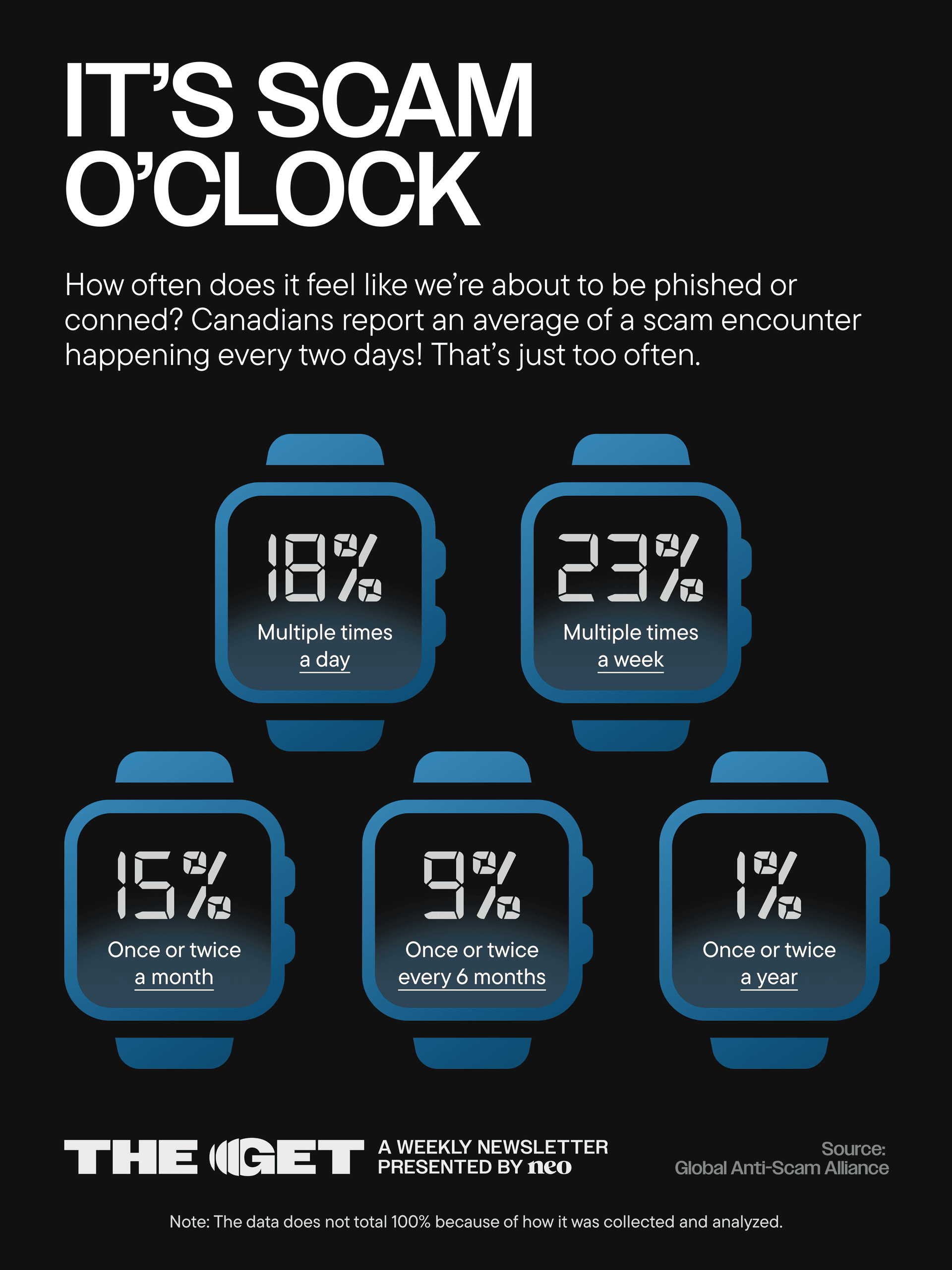
Read more from this issue of The Get:

Rosemary Counter
Rosemary Counter is a Toronto-based writer and journalist whose reporting and essays have appeared in The New York Times, Vanity Fair, The Guardian and others.


The Get is owned by Neo Financial Technologies Inc. and the content it produces is for informational purposes only. Any views and opinions expressed are those of the individual authors or The Get editorial team and do not necessarily reflect the official policy or position of Neo Financial Technologies Inc. or any of its partners or affiliates.
Nothing in this newsletter is intended to constitute professional financial, legal, or tax advice, and should not be the sole source for making any financial decisions. Past performance is not a guarantee of future results. Neo Financial Technologies Inc. does not endorse any third-party views referenced in this content. Always do your due diligence before deciding what to do with your money.
© 2026 Neo Financial Technologies Inc. All rights reserved.