Publié le 15 mai 2026 · 5 min read
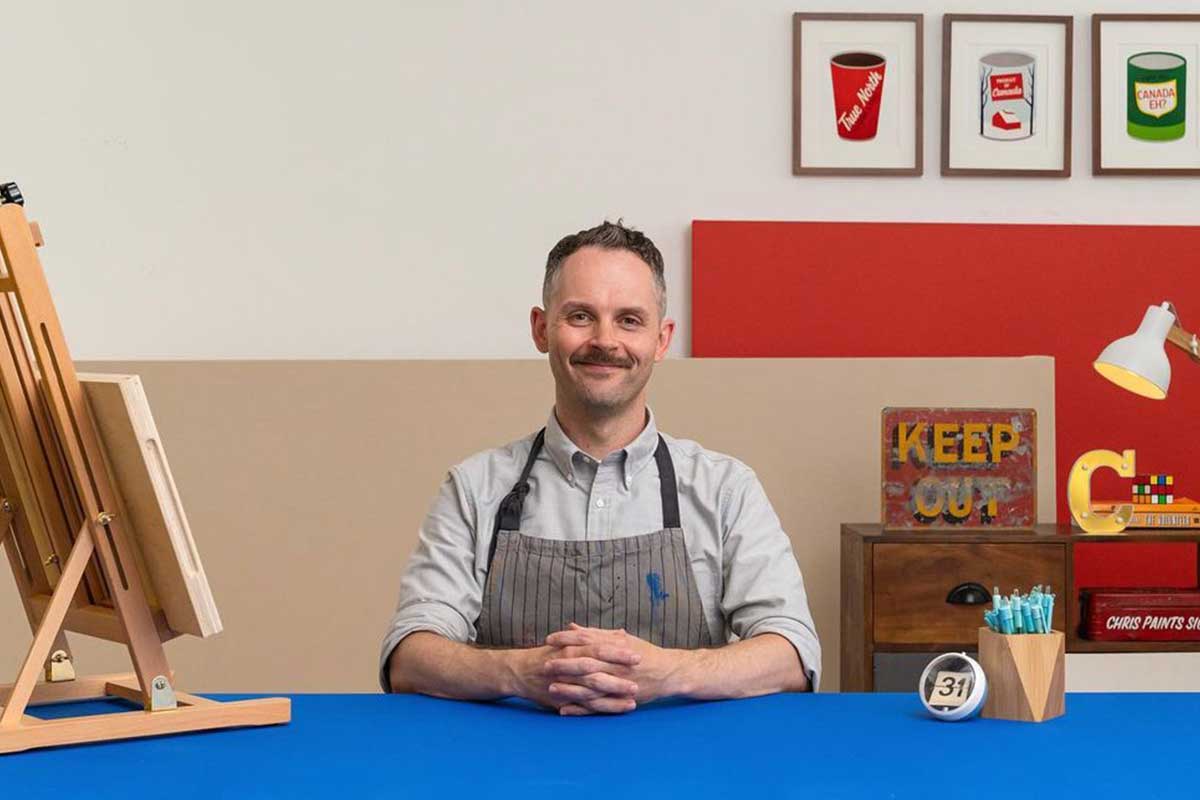
For this week’s MVP, we’re chatting with Christopher Rouleau.
Christopher Rouleau’s connection to art and commerce might best be summed up by the familiar relationship status: “It’s complicated.”
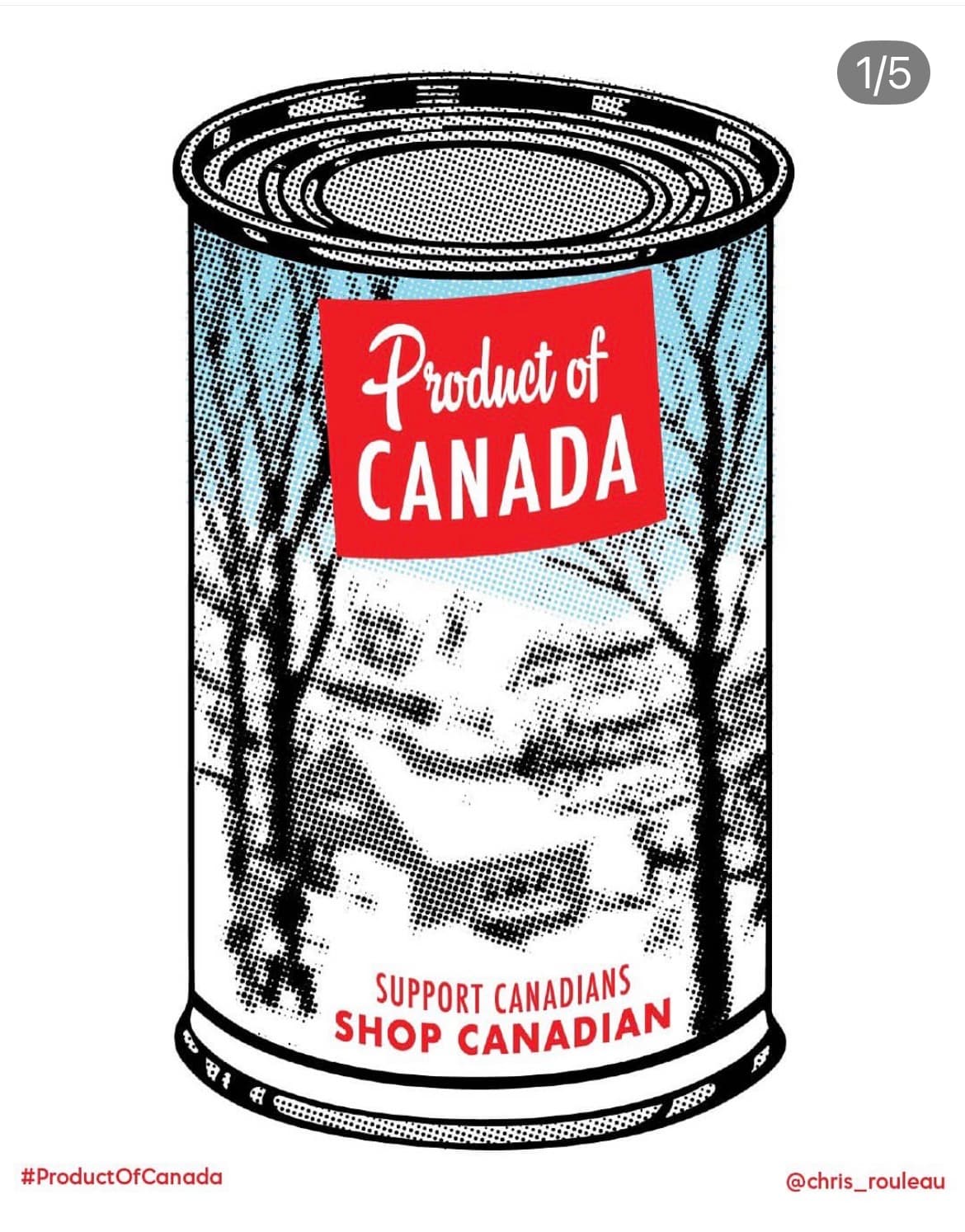
The Toronto-based artist’s greatest hits so far—a vibrant range of canvases and works on paper—draw heavily from pop art-inflected satire. From fictional markdown posters inspired by Toronto’s former bargain landmark Honest Ed’s—featuring slogans like “Dishonest Signs 99¢” or “Leafs Tickets Any Date! $5.99 Pair”—to hand-illustrated spoofs of Canuck canned classics such as pea soup (“Inhabitant of Canada” instead of Habitant) and ginger ale (“Canada Eh?” instead of Canada Dry), Rouleau’s work blurs the line between parody and homage. (The Get readers who’ve tried to get tickets to Jays games, concerts and shows and even FIFA World Cup matches, will appreciate his twist.) With a rapidly growing cult following, Rouleau’s images have the potential to be as iconic in Canada as Keith Haring’s barking dogs or Andy Warhol’s soup cans are in the United States.
Far from an overnight success, Rouleau has carved out a distinct lane within contemporary pop art while working in Toronto for over a decade. It was in this city where he developed his skills, breaking the boundary between retail culture and the art world.
As someone who can be likened to a next-gen Douglas Coupland, Rouleau’s practice departs from conventional models of exhibiting art in Canada. Instead, he moves fluidly between gallery spaces and public, non-elitist marketplaces and corporate work, embracing accessibility without sacrificing conceptual rigor.
Ahead of his upcoming exhibition Selling Canada (May 27 to June 20 at The Red Head Gallery)—a tongue-in-cheek nod to Prime Minister Mark Carney’s now-famous assertion that “Canada will not be sold”—Rouleau reflects on the creative and financial realities of sustaining a life in art.
What are some of the main themes that anchor your upcoming exhibition?
I’ve always been interested in the past, especially Canadian products, advertising and commercial design. My work explores a certain grey area in all of the above which has shaped some of our national identity—aesthetics that represent what’s truly Canadian versus what’s perceived as Canadian. My new work leans into nostalgia—it hits you with a happy feeling, but when you look deeper, there’s more going on beneath the surface.
How do you see the idea of true Canadiana versus hyper-commodified design?
It’s complicated, and I think it’s an ongoing discussion.
Take the maple syrup label—it’s everywhere now, on tote bags, candles, on everything. Yet the specific design that we know from the iconic can came from a 1950s Quebec-based contest won by Sylva Lebrun. It’s not tightly trademarked, which is why it’s so widely used.
Compare that to something like No Name, the Loblaw’s brand, which feels uniquely Canadian and is protected more than the maple syrup can—even though it’s just the Helvetica font.
What themes run through your work?
Capitalism and consumerism are major threads. There’s also a response to AI art. I focused on analog design—older Canadian graphics made by illustrators and lettering artists by hand. It’s an homage to those craftspeople, many of whom were never credited. I’ve taken a stance against AI. I hope we’re in a pendulum swing where we’ll eventually hit a point of realizing its broader ethical implications. Right now, a lot of corporations are embracing it, but I’m hoping there will be a return to valuing human-made work.
Which pieces feel most nostalgic to you personally?
The “12 Brilliant Colors Laurentian” piece is especially strong—it connects to my childhood creativity.
I can smell the pencil shavings. Growing up in a single-parent household, we couldn’t always afford new school supplies, so I reused things. The Cherry Blossom candy box reminds me of my grandparents’ house, though I found it too sweet to eat. Windsor Salt was always in the cupboard—I just liked how it looked, even as a kid.
How do you manage your money?
I’ve been freelancing for 14 years, with good years and bad years. So, it’s about balance and saving when things are strong.
There’s no trust fund or money tree. I rely on a mix of client-based graphic design work, which brings in most of my income, along with selling artwork through my Etsy store, doing wholesale through Faire to reach a larger audience, participating in trade shows and craft fairs, selling locally, and supplementing that with teaching workshops and giving public talks.
Is that the advice you’d give emerging artists?
Yes—things change quickly, so flexibility is important. When the pandemic hit, most of my clients disappeared for 12 months and people held onto their money, so online sales slowed. I had to pivot quickly. You don’t need to be a jack-of-all-trades. But find your niche, stay open and adapt. It’s a bit like taking an improv class—just keep saying yes if you can.
What’s one good financial decision you’ve made?
Paying off my student loans as quickly as possible. The debt caused immense stress, so lifting that weight made a huge difference. Beyond that, I contribute to a TFSA when I can, but I don’t own property.
How do you approach pricing your work?
In the past, I could have charged more, but accessibility is important to me. I like offering different price points so people with different budgets can still engage with the work. For this new collection, I tracked my hours for the first time and factored that into pricing, along with materials and any additional production costs like laser cutting or vinyl. The large grayscale “Scenic Canada” ad took about 34 hours. I was working until my eyes couldn’t handle it anymore.
What’s the question you’re most often asked?
“How did you get to where you are?” The answer is that there’s no single path for artists. My trajectory has been very convoluted and unconventional.
I have a bachelor of fine arts in theatre design, originally thinking I’d become a set and costume designer. Yet, what has helped me keep on the path I’m on right now is just trust—trusting my passion and pushing through tough relationships, breakups and moves. Life is always going to throw you a twist.
Something I once heard that has helped me is: “You are the average of all the people around you.” I interpret that as meaning if you surround yourself with good people, you kind of absorb that.
See more of his work at christopherrouleau.com.

Read more from this issue of The Get:
Elio Iannacci
An award-winning writer, scholar and journalist, Elio Iannacci’s work has appeared in more than 80 publications, including The Globe and Mail, Vogue Italia, The Hollywood Reporter and Maclean’s. His writing also appears in a number of literary anthologies, including the newly released The Nuances of Love, published by Guernica.



The Get is owned by Neo Financial Technologies Inc. and the content it produces is for informational purposes only. Any views and opinions expressed are those of the individual authors or The Get editorial team and do not necessarily reflect the official policy or position of Neo Financial Technologies Inc. or any of its partners or affiliates.
Nothing in this newsletter is intended to constitute professional financial, legal, or tax advice, and should not be the sole source for making any financial decisions. Past performance is not a guarantee of future results. Neo Financial Technologies Inc. does not endorse any third-party views referenced in this content. Always do your due diligence before deciding what to do with your money.
© 2026 Neo Financial Technologies Inc. All rights reserved.