
Published on July 20, 2026 · 5 min read
For this week’s Top Story, we’re uncovering the affordable foods Canadians can count on, as their prices haven’t gone through the roof—yet.
We’ve all read headlines about food prices rising toward the stratosphere. You may have looked at grocery or restaurant bills with more concern than Gayle King eyeing the Blue Origin rocket. But fear not: Some food prices are staying closer to Earth, and you can use this info to keep your food bills in check.
From our sponsor
.png-rLGFSx980jA3P5rYPd5UninHnqZPU4.png&w=1920&q=75)

Not every ingredient breaks the bank
If it seems like your food bills are relentlessly rising, that’s no surprise to grocery consultant Dan Alvo, owner of Khlumus Consulting. Relative to 2022, when prices were already inflated due to the COVID-19 pandemic, he says supermarket prices have increased by about 25% today, adding that the rise is affected by some items more than others. For instance, between March 2025 and March 2026, fresh vegetable prices rose by 7.8%—that’s four times the Bank of Canada’s target inflation rate. It’s also nearly double the average of all groceries measured by the federal government’s Consumer Price Index.
But there’s a halo effect at play, as not every ingredient that makes it to your dinner plate costs more. Some food prices are stable, even declining. Alvo and Tim Cuff, chef consultant with The Fifteen Group, have special insights into why this happens and what products are affected.
Some “stability” is because consumers now get less product for the same price or are made with different ingredients. And some “decline” follows previous price spikes and can be attributed to supply improvements. Here’s what you need to know about why some parts of your food budget take a bigger walloping than others.
Follow better supply to better deals
Supply and demand top the short list of key food cost drivers, Alvo says. We don’t always notice impacts on supply like increases in oil and food transportation costs, or raw materials prices because they happen behind the scenes. But demand is more front and centre, and see it each time we buy food. It’s affected by customers shifting preferences due to trends (like the latest TikTok recipes) or prices. Cuff says that rising beef prices, for instance, led premium chicken prices to follow suit as more customers shifted to it as an alternative protein.
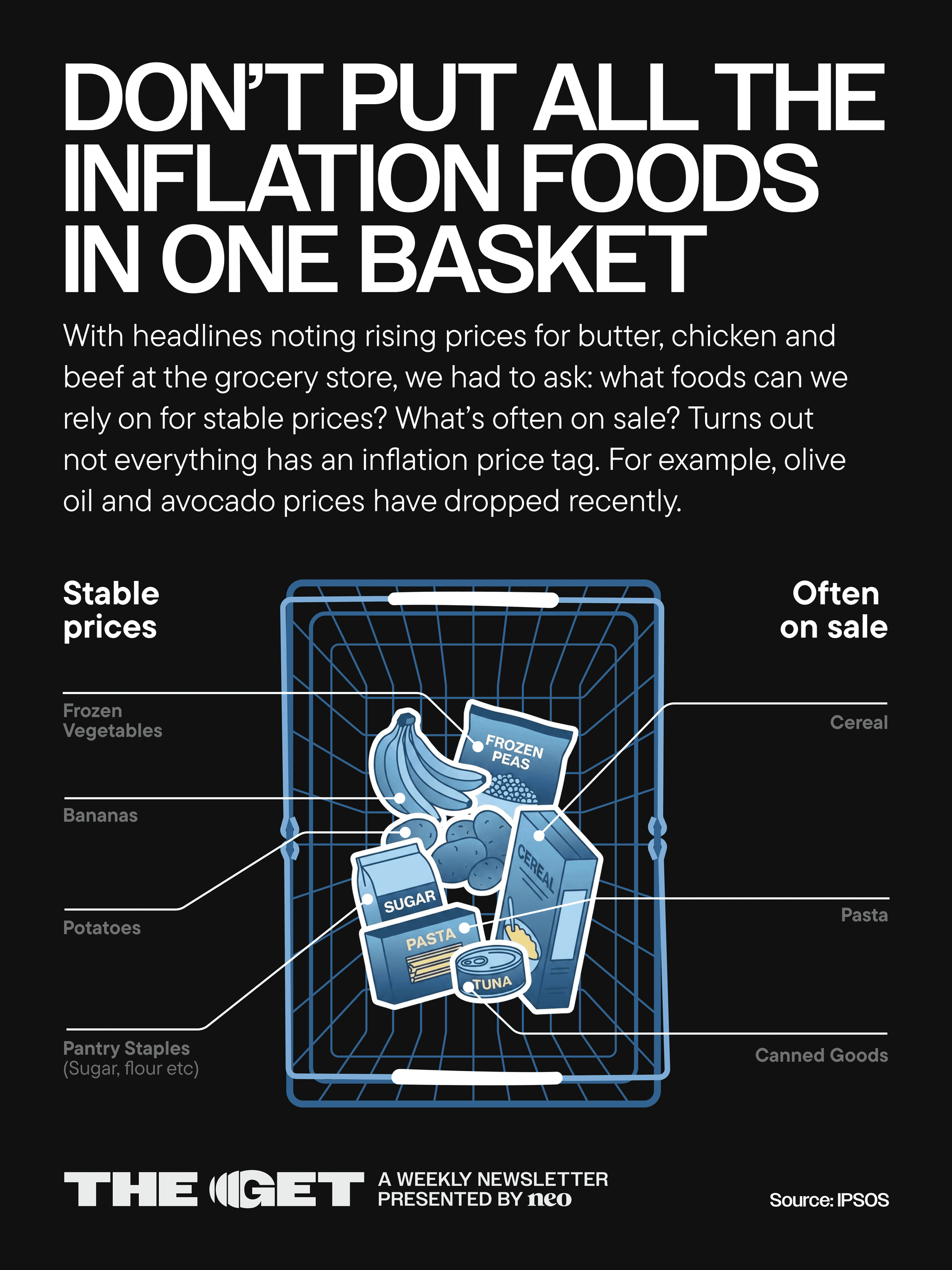
StatsCan reports that tea, peanut butter and some canned soups remain stable, and Alvo says foods like bananas, frozen vegetables and potatoes are seeing less price growth, offering more potential bang for your buck. Others like dried pasta and cereal are frequent sale items offering another way to beat inflation. But few grocery prices are significantly dropping. Some which are falling are benefitting from supply chain improvements, Alvo adds.
Consider olive oil, which shot up in price after droughts in the Mediterranean region led to reduced olive harvests, and, in turn, less EVOO. Prior to the end of 2022, pricepoints of USD$4,000 to USD$4,500 per metric tonne were common, yet olive oil surged to nearly USD$10,300 per metric tonne in January 2024. Retail prices jumped, especially for high quality oils. Canadians paid an average of $17.14 in June 2024, but as of April olive oil dripped down to $11.79—closer to, but not quite as low as, pre-drought prices.
Avocados are also getting cheaper, Alvo says. “Demand has increased tremendously for avocados, and as a result they’ve also improved the supply,” he says. In the first six months of 2025, StatsCan reports an average avocado cost $2.34. During the first four months of 2026, that fell to $1.99, making avocado toast a comparably budget-friendly breakfast. (Millennials, maybe you’ll get that house after all!)
Cost cutting one recipe at a time
Ingredients are sometimes swapped in consumer products and restaurant dishes due to limited supply, but also to drive margins. For instance, chocolate candies and bars become less expensive to produce by replacing cocoa butter with oil, and ice cream becomes cheaper when it contains less real dairy. Then it’s called “frozen dessert” due to packaging regulations. The ingredient mix can lead to stable or lower prices, but also, Alvo says, potential trade-offs in quality that “eventually the consumers will notice.”
Cuff says some ingredient prices have remained relatively stable for restaurants, like less primary cuts of meat (such as chicken thighs), dry pasta or supply managed categories like chicken, eggs and dairy. But increases in minimum wages, food transportation costs and rent still affect menu prices. “These [costs] have to get filtered through menu products,” he says.
Menu engineering helps do this by dissecting dish components to see where money can be saved. For example, pasta made with shredded chicken thighs instead of chicken breasts, or button mushrooms instead of wild ones.
Shrinkflation and how family size is the new regular
Some grocery and restaurant prices which appear stable are illusions. Though the cost is the same, there is less product.
Alvo uses the example of potato chips. What was once a regular-sized bag is now “family size,” and one brand now markets its former Family Size as “Family Size XXL.” It’s not because family chip appetites are flagging—it’s because companies are reducing their costs, to secure greater profits. Even small deletions make a difference. In 1987, the CEO of American Airlines famously saved the company USD$40,000 (about USD$116,000 today) by removing one olive from each first class salad.
Alvo says despite online chatter about shrinkflation, most consumers don’t notice it. “We have to remember that the consumer spends just seconds on a category when they’re making a purchase decision.”
Diners can encounter shrinkflation as portions are downsized, says Cuff. There’s no magic formula for downsizing a plate, he adds. “I would say we’re still giving the same size of protein, but if we’re doing a pasta, we may not do 300 grams, it might be 250.”
Consumers may not mind though: An American Restaurant Association survey found three out of four consumers want smaller portions while spending less money. Lucky for them, that’s a sign of the times.
Read more from this issue of The Get:

Rob Csernyik
Rob Csernyik is an award-winning business and investigative journalist and the author of “A Losing Hand: The Human Costs of Canada's Gambling Epidemic”.



The Get is owned by Neo Financial Technologies Inc. and the content it produces is for informational purposes only. Any views and opinions expressed are those of the individual authors or The Get editorial team and do not necessarily reflect the official policy or position of Neo Financial Technologies Inc. or any of its partners or affiliates.
Nothing in this newsletter is intended to constitute professional financial, legal, or tax advice, and should not be the sole source for making any financial decisions. Past performance is not a guarantee of future results. Neo Financial Technologies Inc. does not endorse any third-party views referenced in this content. Always do your due diligence before deciding what to do with your money.
© 2026 Neo Financial Technologies Inc. All rights reserved.