
Published on August 24, 2026 · 5 min read
For this week’s No More Ls column, we’re looking at the cost and benefit of having a prenup.
Love, marriage and money. Three things that are inexplicably tied together and can make for some potent emotional drama—especially when the word “prenup” enters the room. A big shout out to the Real Housewives franchise for showing us just how messy marriage contracts—and the associated theatrics—can get.
From our sponsor
-ve4pxG8jrvoSK1ADZchMZfehqDJ4QL.png&w=1920&q=75)

If you’re planning your “I dos,” that means planning for your financial future together as a couple, but also potentially as a singleton should your happily ever after not last forever. Though this may sound unromantic, it’s not. It’s about being a realist and money smart.
Marriage contracts, or prenuptial agreements, are not a new thing in Canada, but prenups are something more couples now are talking about and signing off on before getting hitched.
Is a prenup a red flag that sets the stage for problems before you’re even married? It depends on who you ask. To dig into all the angles of a marriage contract, what it involves and potential issues, we spoke to family lawyer Emma Katz, a partner at Kelly D. Jordan Law Firm, and psychotherapist Krista Roesler, co-founder of Psych Company, who shared their expertise on the subject.
What is a prenuptial agreement?
A marriage contract is a legal document created by an engaged couple before marriage, says Katz. The cost varies depending on the complexity and rounds of negotiation, but you can expect to pay anywhere from $2,000 to $10,000. The contract offers a way for partners to outline their financial expectations in advance and may help reduce uncertainty should the relationship status change. Areas that prenups typically address:
- Ownership of property brought into the marriage
- Division of assets acquired during the marriage
- Responsibility for debts
- Protection of family businesses
- Treatment of inheritances and gifts
- Spousal support obligations
- Financial responsibilities during the marriage
- Rights regarding investment accounts and savings and chequing accounts
Who should get a prenuptial agreement and what’s involved in creating one
“Figuring out if you need this contract is the first step toward planning for a marriage contract,” Katz says. “Who needs one? If you own property, you should have one. If you stand to inherit money. If you are on a second marriage or have a blended family. If there is one person in the relationship with a significantly higher income.”
Katz says that, in her experience, premarital agreements offer reassurance for many couples, particularly when they have differing financial positions, unique assets or both. The contract may help set expectations and reduce the possibility of disputes later. For most clients she sees, Katz suggests a prenup is not something that’s a surprise sprung on anyone in the relationship; it’s something which has been discussed.
When should you get a prenup?
Any time works for starting the conversation about prenups, of course, but start sorting out the details ideally six months in advance of the marriage.
Typically one party initiates and drives the process, but both individuals in the relationship need to have their own lawyer, says Katz. “If you’re the driver of the contract, you need to make sure your spouse-to-be also gets proper legal advice. It’s critical you spend the time and have it done right; don’t just do a kitchen table agreement.”
The process begins with both parties disclosing all their financial information—think of this part as being a relationship audit.
What assets is each person bringing into the marriage? What debts? How much money do they earn? How much do they expect their partner to earn? What are their expectations around spending? Retirement? Children? Aging parents? Inheritances?
“You need everyone to know what you are giving up or else they can’t properly sign off,” says Katz.
Once this information is collected, the initiating individual’s lawyer will draft the marriage contract, then it will be presented to the other party for review, negotiation and sign off. The hope is once it’s complete, it’s tucked away forever more and never looked at again.
Will the prenup talk lead to fights and insecurities?
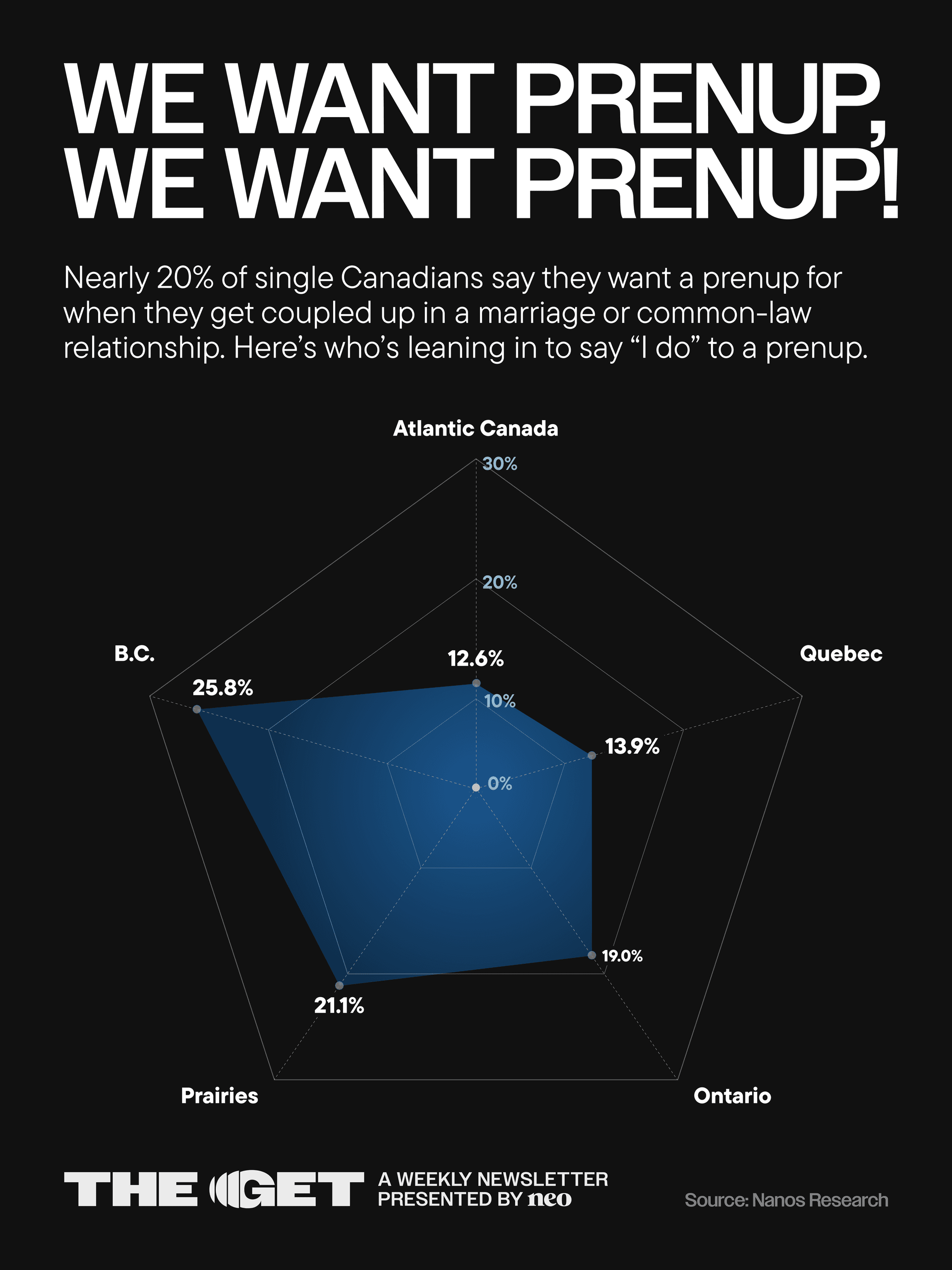
Absolutely. But it’s not as polarizing as it was in the past—thanks to young Canadians being savvier about money than previous generations. We are hearing more about prenups (newlyweds Taylor Swift and Travis Kelce reportedly have a 40-page marriage contract), and couples seem more open about the subject. That said, Roesler strongly believes a marriage contract is still very much seen by the person being asked to sign as an indicator of trust issues.
“I think it creates some unhealthy power dynamics between a couple,” Roesler says. “The person with the money ultimately has more power and control. I think in a perfect relationship a prenup is not the healthiest solution, but the truth is most relationships and people are imperfect, and we are all dealing with many challenges.”
According to Roesler, people get together under all sorts of unforeseen circumstances and at various points in their lives, each bringing lots of accumulated baggage to the table. She believes a prenup may, at times, be seen as a sharp tool that can cut through the noise and shape an understanding that can keep people together despite their unique baggage.
How bring up prenup in a conversation with your partner
For Canadian couples considering a marriage contract, Roesler has some thoughts on how to navigate uncomfortable conversations. The key to making the prenup chat a positive one is talking openly and honestly about the issues and challenges they both have individually and as a couple.
“This should be an ongoing conversation in any healthy relationship, and hopefully they are both used to talking about tough things,” Roesler says. “There is no easy way to discuss a prenup. It’s emotionally and mentally a very hard topic.” She advises the person opening the conversation “to remind your partner how much you love them, why a prenup is a good idea and its benefits.”
Read more from this issue of The Get:

Alison McGill
Alison McGill is an award-winning editor, writer, brand strategist, media personality and podcast host. Renowned as one of Canada's leading wedding experts, Alison is currently a regular contributor to ELLE Canada, The Kit, The Toronto Star, and others.



The Get is owned by Neo Financial Technologies Inc. and the content it produces is for informational purposes only. Any views and opinions expressed are those of the individual authors or The Get editorial team and do not necessarily reflect the official policy or position of Neo Financial Technologies Inc. or any of its partners or affiliates.
Nothing in this newsletter is intended to constitute professional financial, legal, or tax advice, and should not be the sole source for making any financial decisions. Past performance is not a guarantee of future results. Neo Financial Technologies Inc. does not endorse any third-party views referenced in this content. Always do your due diligence before deciding what to do with your money.
© 2026 Neo Financial Technologies Inc. All rights reserved.