Updated on June 24, 2026 · Published on June 8, 2026 · 5 min read
By Bob Joyce, CPA, CA, CFP, and owner of Fair Winds Financial Coach in Hacketts Cove, N.S.
As told to Ian Portsmouth.
Here’s the answer to this week’s reader question.
In the next five years, I have to withdraw all my money from my RRSPs. What is the best option: wait until the last year to withdraw, withdraw one fifth each year, or convert to a RRIF?
—Wlodzimierz
How to withdraw money from RRSPs
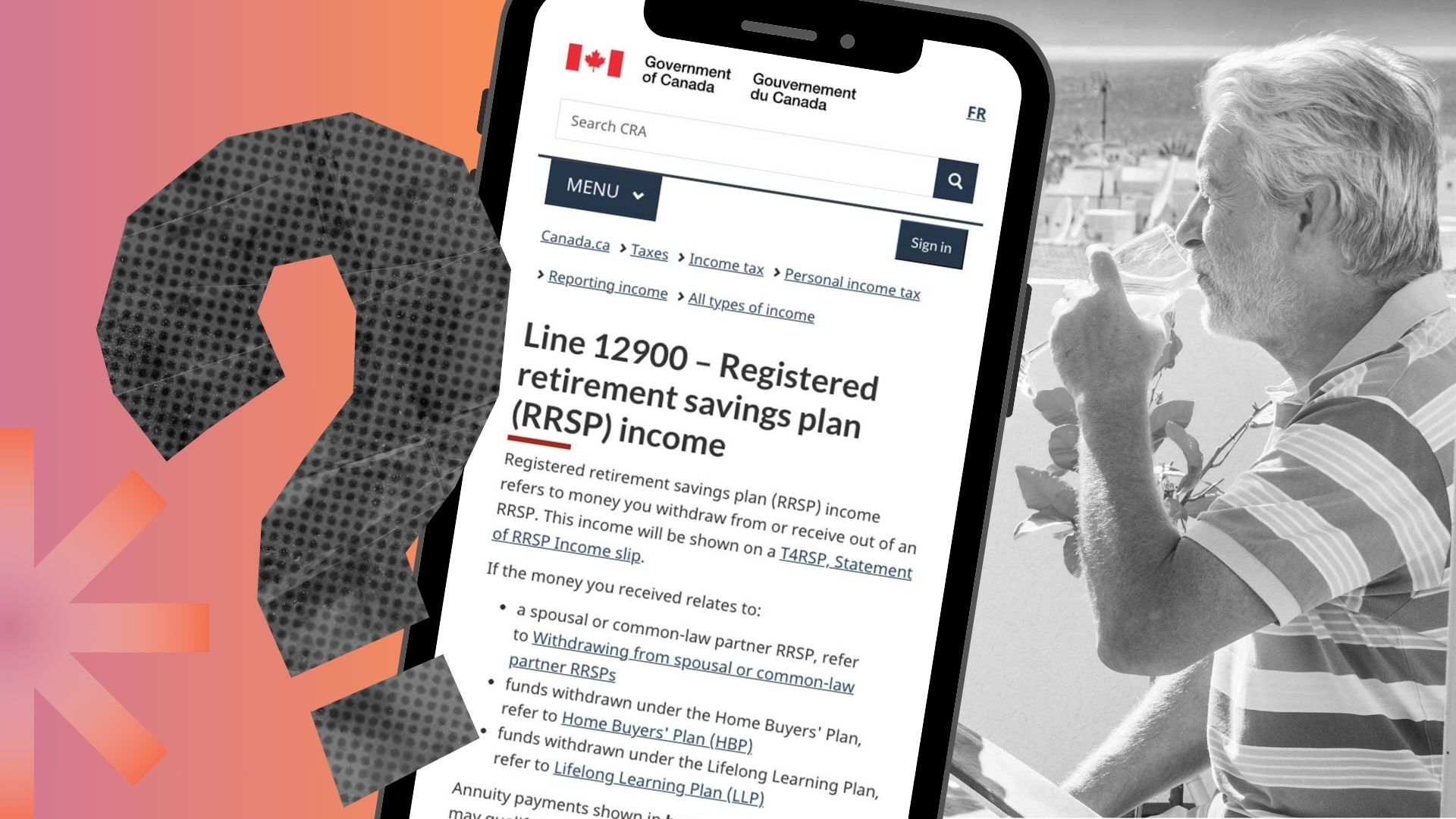
Drawing money out of a registered retirement savings plan (RRSP) is a process called decumulation. By law, Canadians must close their RRSPs by the end of the year in which they turn 71. When you do, you have the following options:
- take the cash
- transfer the savings into another registered account, the registered retirement income fund (RRIF)
- buy an annuity (an insurance product that provides regular income)
- do any combination of the above, such as splitting the funds between a RRIF and an annuity.
Consider these options carefully before settling on your decumulation strategy, because each one will have a different effect on your financial situation for years to come.
Regardless of your rationale for closing your RRSPs over the next five years, the approaches you’re considering can help illustrate some key benefits and drawbacks of each option.
Let’s review each scenario.
1. Wait until the last year to withdraw
The best way to draw everything out of your RRSPs in cash is essentially a question of getting the money out in the most tax-efficient way, because any funds you withdraw are treated as taxable income. The general principle is this: it’s financially advantageous to pay tax sooner at a lower rate than to pay it later at a higher rate.
Taking all the money in a lump sum is likely to be the least tax-efficient option, because every dollar of income moves you toward a higher tax bracket.
Let’s say you’re based in Ontario and your regular income in 2026 is $100,000. Before factoring in any deductions, tax credits or expenses, you’d pay $23,636 in federal and provincial tax—a combined rate of 23.6%. Now let’s add $150,000 from your RRSPs, taking you to $250,000 in total income. Your combined tax rate jumps to 32.7%, resulting in a tax bill of $81,638. The tax rate on the $150,000 from the RRSPs is actually 38.7%, because much of it falls into higher tax brackets than your first $100,000 of income.
That’s not to say a lump-sum withdrawal always results in a higher tax rate. If your RRSP savings are small, withdrawing the full amount might not lift you into the next tax bracket. And if you’re already paying taxes at the highest rate, your tax rate will stay there no matter how much is in your RRSPs.
2. Withdraw one-fifth of your RRSP savings each year
Generally, this will be more tax efficient than taking all the money in one lump sum. By splitting your total RRSP withdrawal evenly over five years, you’re reducing the amount of income that could spill into higher tax brackets in any given year. In the example above, your taxable income each year would rise to $130,000, with a combined tax rate of 25.9%; the incremental $30,000 would be taxed at 33.5% (compared to 38.7% if you took out all $150,000 at once). This would result in tax savings of $7,737 over the five-year period.
Of course, these calculations assume your non-RRSP income doesn’t change over the five-year period. But if you have a good sense of whether and when your annual income might rise or fall significantly—say, if you stop working or start taking your Canada Pension Plan (CPP) benefits—you can try to optimize your RRSP withdrawals each year rather than sticking to an even five-way split. You can test different scenarios using this calculator.
3. Convert the full amount to a RRIF
RRIFs and RRSPs are similar in that the investments held in these accounts will grow tax-free and cash withdrawals are taxed as income. The primary difference is that while RRSPs are used to save for retirement, RRIFs are designed to generate income during your retirement.
If you consider nothing more than the tax treatment of your RRSPs, then transferring them to an RRIF is your best option for one simple reason: transfers from RRSPs to RRIFs are tax free.
As soon as you’ve established a RRIF, however, you are required to withdraw a minimum amount—and the money is treated as taxable income. The minimum withdrawal calculation is based on your age and account balance as of December 31 of the previous year.
If you turned 55 last year, for instance, your minimum withdrawal this year would be 2.86% of your RRIF’s balance on December 31 of the previous year; at age 67, the minimum withdrawal rises to 4.35%; by age 80, it’s 6.82%. (There’s no upper limit on RRIF withdrawals.) Still, no matter how old you are when you transfer your RRSPs to a RRIF, you’ll be minimizing the immediate tax impact compared to either withdrawing your RRSPs all at once or over five years.
There are other advantages to transferring RRSPs to a RRIF rather than cashing out. When you’re 65 or older, RRIF-generated income is eligible for the pension income amount, a non-refundable tax credit that can reduce your tax bill by several hundred dollars, and is also eligible for income splitting, which allows you to share up to 50% of the RRIF income with your spouse when filing your taxes.
Don’t neglect other options
Before you settle on an RRSP drawdown strategy, look at other decumulation options. For instance, you could transfer your RRSPs into an annuity, a type of insurance contract that makes a guaranteed, regular payment to you over a specified term. You could also take a combined approach, transferring some of your RRSP funds into an annuity, some into a RRIF, and taking the rest in cash. You could even do the transfers in stages, a strategy called partial conversion.
Withdrawing from your RRSP
Finally, consider your full financial picture. The best decumulation route to take will depend on your current age, available tax breaks, expected changes to your sources of income, and your total income—not only in the next five years, but every year of your retirement. You don’t want to pay more tax than you need to—but you do want to be able to fund a comfortable retirement.
Ian Portsmouth is an award-winning writer and editor specializing in business and personal finance. He is based in Toronto.
Read more from this issue of The Get:



The Get is owned by Neo Financial Technologies Inc. and the content it produces is for informational purposes only. Any views and opinions expressed are those of the individual authors or The Get editorial team and do not necessarily reflect the official policy or position of Neo Financial Technologies Inc. or any of its partners or affiliates.
Nothing in this newsletter is intended to constitute professional financial, legal, or tax advice, and should not be the sole source for making any financial decisions. Past performance is not a guarantee of future results. Neo Financial Technologies Inc. does not endorse any third-party views referenced in this content. Always do your due diligence before deciding what to do with your money.
© 2026 Neo Financial Technologies Inc. All rights reserved.