Published on November 10, 2025 · 4 min read
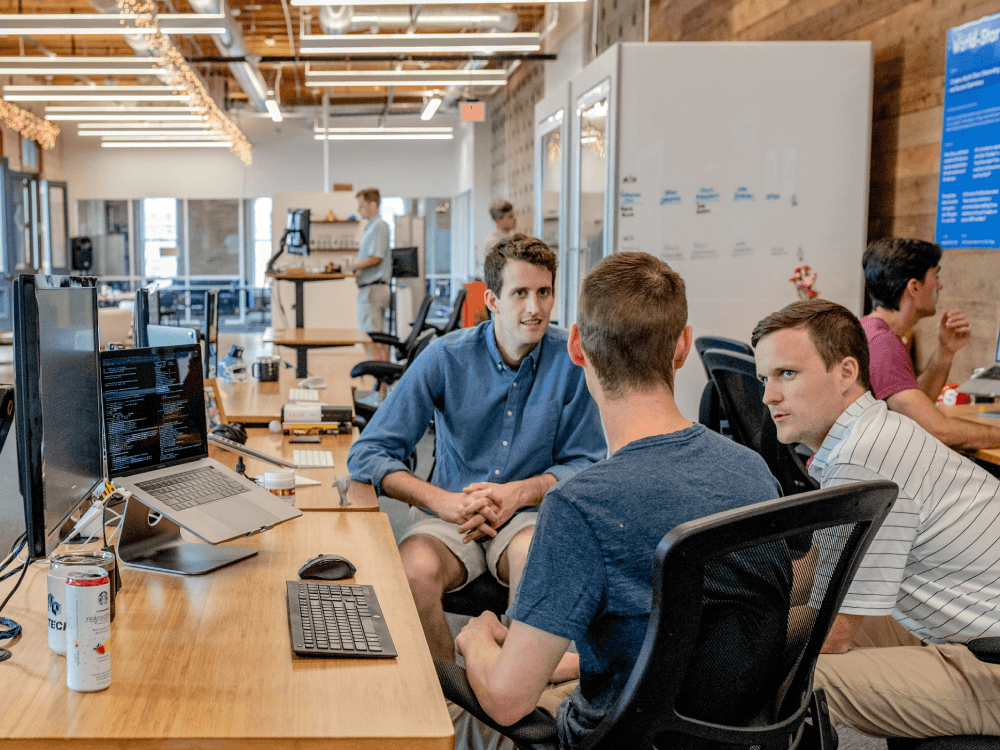
For this week’s top story, we’re looking at how the tech industry aims to use AI at work.
Movies will have you believe our relationship with AI will go from friend to foe fairly quickly (think Will Smith in I, Robot and Allison Williams in M3GAN). But before that happens, many are wondering if this technology will take over our tasks at work and eventually our jobs.
Why the concern? According to Statistics Canada: “Automation is generally understood to be the use of machines to perform simple, routine and non-cognitive tasks. AI, on the other hand, can perform complex, non-routine and cognitive tasks. AI’s capabilities are growing, and it is unclear how powerful it may be in the future.”
As AI’s skills improve, many of us humans are worried. A 2023 Research Co survey found that 77% of Canadians are “very concerned” or “moderately concerned” about AI taking over jobs currently performed by people. However, that sentiment may be changing, according to a 2025 survey by Abacus Data that reveals 47% of working Canadians think they might have to change their job or their career because of AI.
So, what does the tech industry think?
Overall, the speakers discussing AI at the 2025 Elevate Festival, a tech and innovation conference, are optimistic. The take-home message was that AI can improve productivity, rather than reduce labour costs. Here’s how four speakers broke it down.
Setor Zilevu, PhD
The lead user experience researcher at Meta (which owns Facebook) and adjunct professor at NYU studies human interaction with AI and user experience. His view is positive. “When AI is designed carefully,” he says, “it supports, it doesn’t replace.” He points to an ideal workplace where “AI offers the ability for us to have real-time data, feedback loops and precision guidance,” but human-to-human bonds remain intact. “AI is a teammate, not the coach. We not only need to understand what it’s producing, but how and why. And then we as humans need to be able to step, reject, or modify the responses.”
Naeem Talukdar
For CEO and co-founder of Moonvalley, a Toronto company developing video-generation tools, AI is a tool that can democratize animation. “I’m quite optimistic about it too,” he says. “If more and more people can make more stuff, more people have access to making animation.” As an example, only a small percentage of animators would be able to work with a top visual effects company, like Industrial Light & Magic, and make movies like Ultraman: Rising and Good Night Oppy. But with AI, more people could create such films.
The use of AI, Talukdar says, reminds him of what happened when digital cameras were introduced. Some companies like Kodak were in trouble, but filmmakers simply adopted a new tool. “ Instead of people shooting on film, they shoot on digital. It’s not like filmmakers went away.”
Andrew Forde
All workers and leaders need to increase their AI fluency, according to the KPMG Canada partner for technology strategy and digital transformation. Fluency, he says, is all of “the foundational skills that ensure usefulness, even as specific tools come and go.” Companies need people who can work with this technology; many AI pilots fail because there’s no corporate structure nor organization built around how to get the most out of artificial intelligence. He challenges leaders to “Start with your business challenge, not the technology. Still to this day, too many companies ask how we can use AI, versus what specific business problem could AI help solve. This is where AI literacy pays off, when your team understands that.”
Ed Clark
The Canadian retired banker and former director of Thomson Reuters Corporation board, says to look at AI as someone who can fill your space and do the work you don’t want to do.
For the Thomson Reuters human resources committee, which he also chairs, he suggested that the company get together to discuss “What do you hate about your job?” The solution: “That’s what AI will eliminate.” Instead of AI being seen as a threat, they embraced it for tedious tasks, like filling out expense forms.
His advice for those working at a company where they don’t yet have access to AI functions: ”Speak up!” Ask for support on tasks that get in the way of your own productivity.
How is AI affecting your job search?
A report from the Toronto Star reveals that job postings for recent computer science grads are down. But experts suggest this is a result of a perfect blend of several factors, including a weak Canadian economy, AI use, and an atypically large onslaught of grads. (Gen Z and Gen Alpha are having a hard time finding work.)
Even if you’re trying to work in computer science, it’s tough to find a job. We’re in what HR folk call an “employer’s market,” meaning hiring managers have their choice of employees, instead of the other way around.
You can take the advice of those experts above: lean into AI and get it on your resume. Learn how you can talk about your own productivity in interviews and don’t be afraid of technology. Without humans, AI would just be talking to itself. How productive would that be?

Lisa Hannam
An award-winning editor and journalist, Lisa Hannam is the Editor-in-Chief of The Get. She has previously been at the helm of celebrated Canadian publications, including MoneySense. She completed the Canadian Securities Course in 2024.


The Get is owned by Neo Financial Technologies Inc. and the content it produces is for informational purposes only. Any views and opinions expressed are those of the individual authors or The Get editorial team and do not necessarily reflect the official policy or position of Neo Financial Technologies Inc. or any of its partners or affiliates.
Nothing in this newsletter is intended to constitute professional financial, legal, or tax advice, and should not be the sole source for making any financial decisions. Past performance is not a guarantee of future results. Neo Financial Technologies Inc. does not endorse any third-party views referenced in this content. Always do your due diligence before deciding what to do with your money.
© 2026 Neo Financial Technologies Inc. All rights reserved.