Published on March 30, 2026 · 5 min read
For this week’s top story, we’re diving into gas prices, looking for signs that indicate when the cost at the pump is going to go up.
Pain at the pumps has taken on a whole new meaning lately. The war in the Middle East has sent gas prices soaring. Oil hit USD$100 a barrel in March, almost double from the start of the year. Suddenly, filling up your car feels less like a quick errand and more like something that needs a financial advisor. What happens next is hard to predict. Will prices keep climbing? Or will they fall soon?
From our sponsor


It can feel like a coin toss. But it isn’t. Gas prices aren’t random. The number on the sign at your local station reflects a long chain of events that starts months earlier, thousands of kilometres away. Understanding that path can help you figure out where prices are headed.
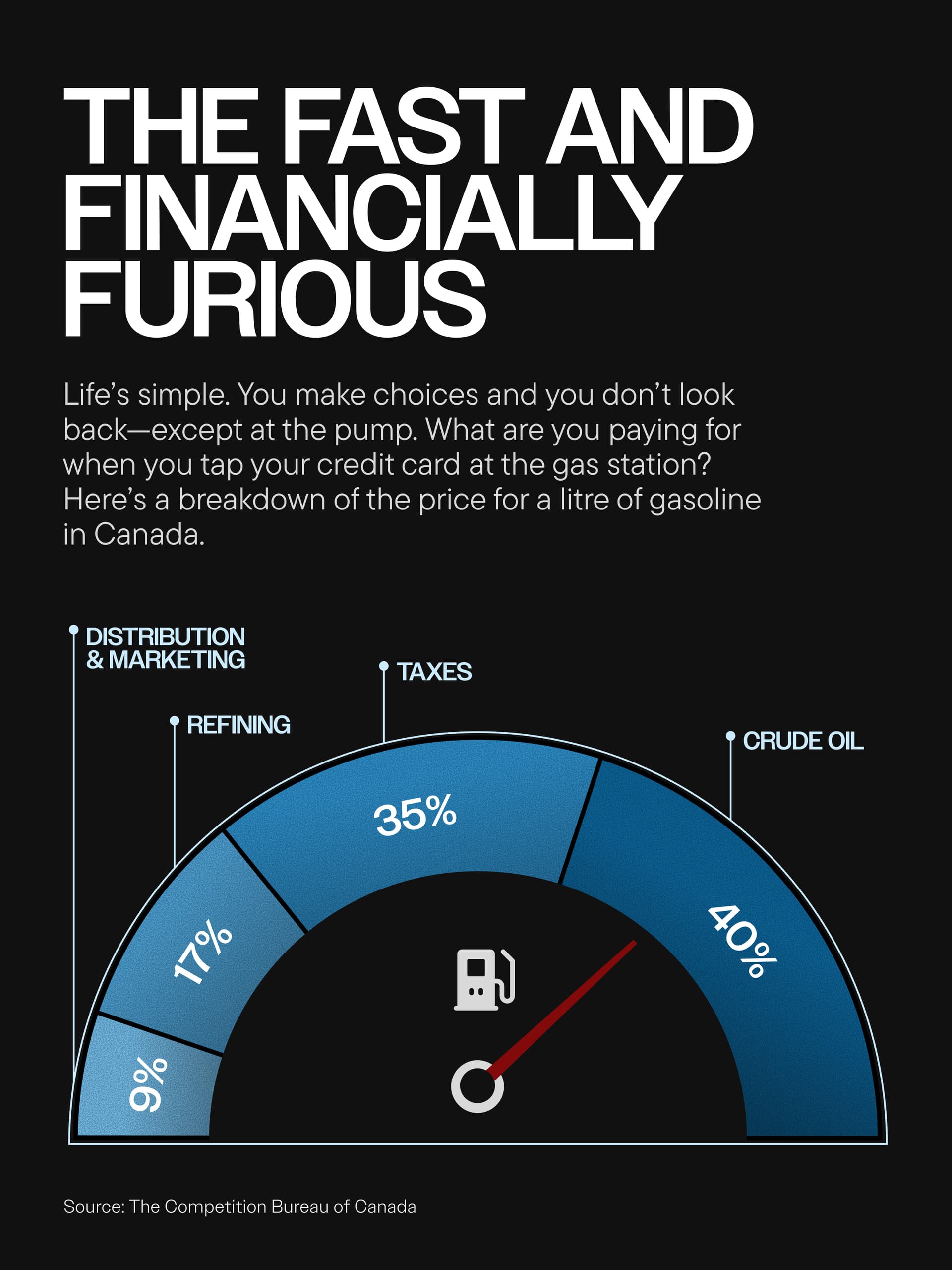
It all begins with crude oil, the sticky stuff refined into gasoline. Crude oil typically accounts for about 40% to 50% of what you pay at the pumps, says Matt McClain, a petroleum analyst at GasBuddy, which tracks fuel prices across Canada and the United States.
How crude oil affects the price Canadians pay for gas
Crude is the single biggest driver of price swings. When crude oil rises, gasoline prices usually follow. How fast depends mainly on why oil is climbing. Sudden shocks or supply shortages—such as those caused by the war between the U.S., Israel and Iran—can push pump prices higher almost overnight. But if members of OPEC (the Organization of Petroleum Exporting Countries, which controls more than a third of global oil output) decide to cut production, the price increase usually takes longer to work through the system. “The more urgent the situation, the faster the impact at the pumps,” McClain says.
To get an early warning, watch two key oil benchmarks: West Texas Intermediate (WTI) in the United States and Brent Crude in Europe. These serve as reference prices for buyers and sellers worldwide. Both are easy to track online. You don’t have to check them every day. But if they’re trending upward, pump prices will likely follow. And when they spike suddenly (as they did recently after the U.S. and Israel attacked Iran), it’s smart to fill your tank right away.
The oil market alone doesn’t explain why prices vary so much across Canada or even across town. Other factors—taxes, supply, competition, location and season—also affect what you pay, says Suzanne Gray, sales and service consultant at Kalibrate Canada, a data and analytics firm that works with gas station retailers.
How taxes affect the price Canadians pay for gas
First, taxes. Federal and provincial fuel taxes are built into every litre, and some cities add their own levies. That’s one reason why drivers in different provinces can pay different prices on the same day.
How supply affects the price Canadians pay for gas
Supply chains matter, too. Gas doesn’t just appear at stations. It must be refined, transported and stored. Regions in Canada with nearby refineries tend to have lower prices because supply is steadier and shipping costs are lower, Gray says. Areas that rely primarily on imported fuel, such as British Columbia, Quebec and Ontario, are more exposed to disruptions and, therefore, price spikes.
How competition affects the price Canadians pay for gas
Competition also plays a role. In large cities with many stations close together, companies may lower prices to attract customers. In smaller towns or rural areas, fewer choices mean less pressure to discount.
Even the station itself matters. High-volume locations, especially those making additional sales in large convenience stores, car washes or fast-food counters, can afford to sell fuel for slightly less to lure customers. Smaller stations usually cannot compete.
How much will you pay for gasoline? It depends where you live
British Columbia often has the highest prices in the country. It has limited refining capacity and so relies on fuel from elsewhere. Vancouver and Victoria also charge municipal fuel taxes, which push prices even higher.
Quebec is often near the top too, partly because of its cap-and-trade carbon-pricing system.
The Prairie provinces are usually the cheapest thanks to an abundant local supply and refining capacity.
Ontario and Atlantic Canada tend to fall somewhere in the middle on price.
Put it all together, and where you live matters almost as much as global oil prices.
What time of year is it? That counts, too
Canada also has two gasoline seasons: winter and summer. In winter, we drive less, so gas is often cheaper. In summer—hello road trips—we tend to hit the road more often. “You have demand running into supply,” Gray says, which means we’re going to pay more at the pumps.
Two other factors push prices higher in warmer months. First, oil companies switch from winter to summer fuel blends. The latter costs more to make. Second, refineries often shut down in spring for maintenance, tightening supply and causing temporary price spikes. Similar shutdowns happen in the fall, which may also force prices up briefly.
How to find the cheapest gas in your area
Finding the cheapest gas from day to day can be tough, but not impossible. Several apps can help. GasBuddy compares prices at stations across Canada to help you find the lowest price nearby. Gas Wizard also offers a price predictor that estimates gas prices two to three days ahead, helping you decide whether to fill up now or wait.
Prices can also vary by day of the week. Research from GasBuddy found that, in the States, Sundays are typically the cheapest day to fill up, while Wednesdays through Fridays are usually the most expensive. No such study has been done in Canada but based on what impacts the price of gasoline, the results could be similar here.
If you really want to save, however, the best advice is simple: slow down, says McClain. “The more you go over the speed limit, the more fuel you are going to burn and you’ll get less fuel efficiency” he says. If you drive at 120 km/h on the highway, for example, you’re using about 20% more gas than if you drove at 100.
“It’s quite literally money you’re sending out your tailpipe.”

Robert Gerlsbeck
Robert Gerlsbeck is a freelance editor and journalist. He is based in Kingston, Ont.


The Get is owned by Neo Financial Technologies Inc. and the content it produces is for informational purposes only. Any views and opinions expressed are those of the individual authors or The Get editorial team and do not necessarily reflect the official policy or position of Neo Financial Technologies Inc. or any of its partners or affiliates.
Nothing in this newsletter is intended to constitute professional financial, legal, or tax advice, and should not be the sole source for making any financial decisions. Past performance is not a guarantee of future results. Neo Financial Technologies Inc. does not endorse any third-party views referenced in this content. Always do your due diligence before deciding what to do with your money.
© 2026 Neo Financial Technologies Inc. All rights reserved.