Published on July 2, 2026 · 3 min read
By Julien Brault, founder of MooseMoney.
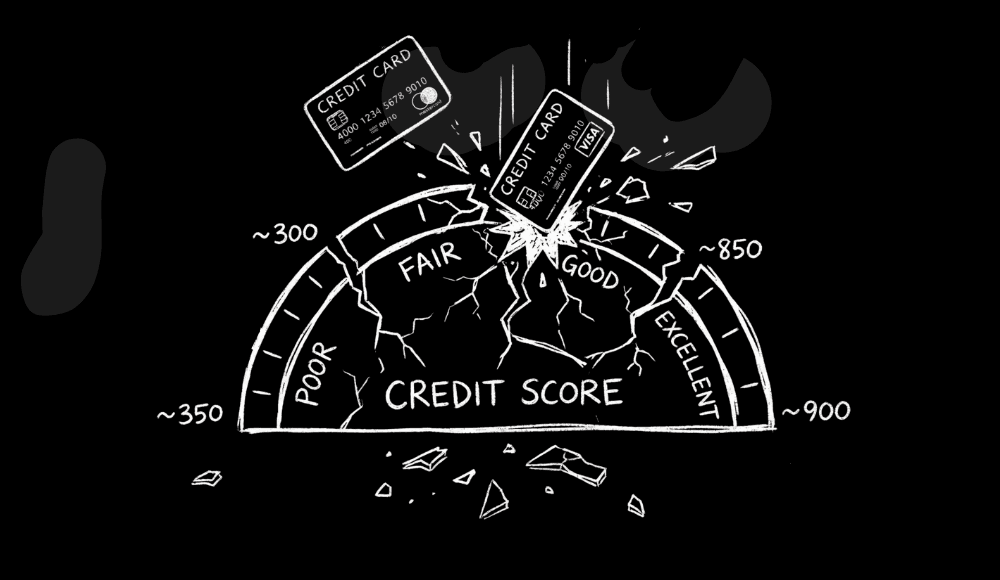
Applying for a credit card will likely cause a small, temporary dip in your credit score, but it should not cause lasting damage. The drop typically comes from a hard credit inquiry, which is recorded on your credit report each time a lender formally checks your file with your permission. A single hard inquiry may shave off only a few points, and the effect tends to fade within a few months.
Richard Goyder, Chief Credit Officer at Neo Financial, put it plainly: "I think people are sometimes too concerned about hard checks in the sense that it can reduce your score slightly, but it's not going to have a dramatic effect especially not compared to things like whether you pay your bills on time or not."
That context matters. In Canada, the factors that weigh most heavily on your credit score are payment history (roughly 35% of your score) and credit utilization (roughly 30%). Hard inquiries account for only about 10% of your score calculation. So while a credit card application does register on your file, it ranks well below habits like carrying a high balance or missing a payment.
Why You Should Seek Soft Inquiries & Avoid Hard Inquires
A hard inquiry happens when you formally apply for a credit product and give the lender consent to pull your full credit report from Equifax or TransUnion. Each hard inquiry is recorded and stays on your file for three years in Canada, though its effect on your score diminishes well before that.
A soft inquiry happens when you check your own credit, when a lender pre-screens you for an offer, or when you use a pre-qualification tool. Soft inquiries do not appear to other lenders and have zero impact on your score.
This distinction is important because some card issuers now let you check which products you qualify for through a soft pull before you commit to a hard one. Neo Financial, for example, uses this approach. "When you first apply with Neo, we're only doing a soft check and we will use that to tell you what product you qualify for before we do the hard check," said Goyder. That means you can see whether you are a fit for the Neo Mastercard or the Secured Neo Mastercard without any score consequence, and only trigger the hard inquiry once you decide to proceed.
Goyder also offered a practical tip that applies to any issuer: "Any credit card application process you go through needs to get your consent to do a hard credit check. So pay attention to the stage at which it asks you to consent to a hard credit check." If you are just browsing or filling out an initial form and the site has not yet asked for your explicit consent, you are likely still in soft-check territory.
Why Multiple Applications in a Short Period Do the Most Damage
One hard inquiry is manageable. Several in quick succession are not. When lenders see a string of recent credit applications on your report, they may interpret it as a sign of financial distress or aggressive credit-seeking, which makes them less willing to approve you.
Goyder was direct about how his team views this pattern: "Applying to multiple credit cards in a short period of time will not only have a negative impact on your credit score, but it's one of the characteristics that we look at, because it carries with it the risk that this person is engaged in credit seeking behavior. Doing so does tend to hurt your credit score and reduce your chances of being approved for a Neo credit card."
It is worth noting that mortgages and auto loans are treated differently by credit scoring models. If you rate-shop for a mortgage and multiple lenders pull your credit within a 14 to 45 days window, those inquiries are typically bundled and counted as a single event. Credit card applications do not receive that same treatment. Each application counts as its own inquiry, so the impact compounds if you apply for three or four cards in the same month.
Related Posts
View All
How to build your credit from scratch as a Canadian immigrant
Your credit history doesn't transfer to Canada. Here's how to build credit from the ground up in six to 12 months.

What’s the average credit score in Canada in 2026?
What does your credit score mean for your goals? Discover the average credit score in Canada, what good and bad scores look like, and where you fall on the spectrum.

The inconvenient truth about credit builder loans in Canada
Before you lock your money away in a credit builder loan, read this.