Updated on July 2, 2026 · Published on April 15, 2026 · 3 min read
If you are searching for the best no-fee account in Canada, these four options charge zero monthly fees while still offering competitive interest, unlimited transactions, and modern digital tools. Here is what each one delivers and where they differ.
1. Neo Chequing Account
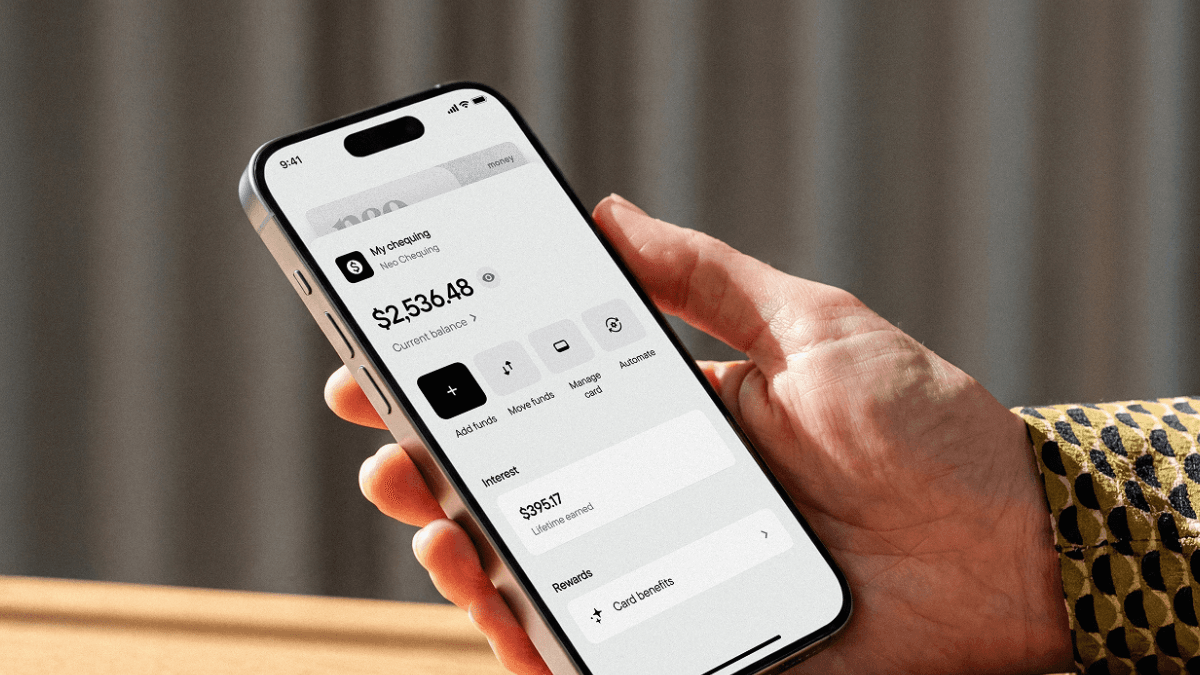
With a Neo Chequing account, you can pay your bills, receive Interac e-Transfer® payments and track your spending to help you build better habits and make smarter decisions. With this account, you can also get a Neo Money™ card: a prepaid Mastercard that earns 1%¹ on cashback on gas and groceries.
Funds are held at a member institution of the Canada Deposit Insurance Corporation (CDIC), so your deposits receive the same federal protection you would get at a traditional bank².
From our sponsor

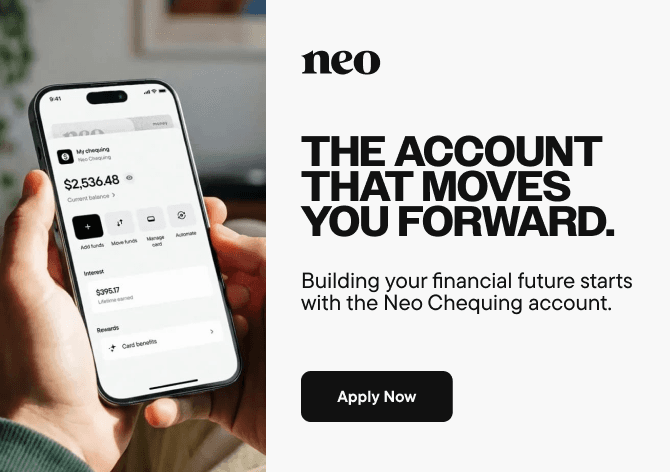
For those looking to get their money to work harder, the Neo Savings account comes with a 2%³ earnings rate. With the Grow membership ($14.99 per month), you can unlock a 2.75% Neo Savings rate.
2. EQ Bank Personal Account
EQ Bank's hybrid Personal Account functions like a chequing account but earns like a savings account. It charges no monthly fees, requires no minimum balance, and offers unlimited free transactions including e-transfers.
EQ Bank consistently provides one of the higher everyday interest rates among Canadian digital banks (a 1% base rate that jumps to 2.75% when you set up qualifying direct deposits), which means your chequing balance actually grows.
3. Simplii Financial No-Fee Chequing Account
Simplii Financial, a division of CIBC, offers a no-fee chequing account that includes unlimited debit purchases, bill payments, and withdrawals at zero cost. You also get free access to more than 3,400 CIBC ATMs across Canada, which is a significant advantage if you regularly need physical cash.
Simplii provides a debit Mastercard for online and in-store purchases wherever Mastercard is accepted. Overdraft protection is available for a $4.97 monthly charge (only when used), on top of a 19% annual interest on overdraft balances. Accounts without this protection are subject to a $10 non-sufficient funds (NSF) fee.
4. Tangerine No-Fee Chequing Account
A subsidiary of Scotiabank, Tangerine's chequing account has no monthly fees, no minimum balance requirement, and unlimited free debit transactions. You get free access to 3,500 Scotiabank ATMs across Canada.
Tangerine provides a Visa debit card, free e-transfers, and mobile cheque deposit. They occasionally runs promotional interest rates on new chequing accounts, but the standard everyday interest rate on chequing balances sits lower than dedicated high-interest accounts (tiered between 0.01% and 0.10%).
Optional overdraft protection is available for a $5 fee per use plus 19% annual interest. Without it, a $10 NSF fee applies. Tangerine also offers automatic savings features that round up purchases or move money on a schedule, which can help with budgeting.
How financial institutions make money on no-fee accounts
A common question is how these institutions survive without monthly fees. Like traditional banks, fintechs make money by acting as middlemen. When you put your cash into a "free" account, the bank uses that money to fund loans like mortgages and lines of credit. They pay you a small amount of interest for the use of your money, but they charge borrowers a much higher rate. They also get a cut every time you buy something. When you tap your card at a grocery store or a shop, the merchant pays a small percentage of that sale back to your bank. This is what the banking industry calls the interchange fee.
Tim Morris, chief banking officer at Neo Financial, explains that fully digital fintech platforms are more capital-efficient than traditional banks. "The way that traditional banks make money is similar to the way that virtual challengers do," Morris explains. "One key difference is that traditional banks have more overhead in terms of manual processes and a physical network of branches. Fintechs will often use this advantage to deliver more benefit to customers across their financial products."

Julien Brault
Julien Brault is a fintech entrepreneur and personal finance expert dedicated to making financial literacy accessible to all Canadians. As the founder of MooseMoney, he currently focuses on helping individuals navigate financial struggles through actionable advice and financial calculators.
Related Posts
View All
The complete guide to joint accounts in Canada
What is a joint bank account? Learn how joint accounts work in Canada, who can open one, the pros and cons, and how to pick the right account.
Canadian fintech platforms are gaining ground over big banks—here's why
That shift is accelerating as digital-only players like Neo Financial deliver tangible financial advantages that the Big Five have been slow to match.

How to open a bank account when you’re an international student in Canada
International students can open a Canadian bank account with a valid ID and proof of a Canadian address—no SIN required. Here are the steps.