
Published on February 2, 2026 · 7 min read
For this week’s Reality Cheque, we’re looking at the money myth that understanding the economy requires a degree.
“It’s a recession when your neighbour loses his job. It’s a depression when you lose yours.”
That’s a famous quote attributed to Harry Truman, U.S. president in the 1940s and ’50s, and it captures one way the economy can suddenly feel personal. Most of us understand the point.
Still, it can be hard to make sense of how specific measures of the economy affects us as individual Canadians. News headlines are filled with talk of inflation, interest rates, stock markets and exchange rates. Yet those forces can seem distant from your own household finances.
Together, though, they have a profound effect. Economic conditions shape how much you earn, what you can afford and how optimistic you may be about the future. Even if you don’t follow economic news headlines closely, you feel its effects every day—when food costs more, your rent rises or your paycheque grows.
“People read about some of these economic indicators in the news, and they may wonder what that’s going to mean for them in their own personal lives,” says James McNeil, an associate professor of economics at Dalhousie University. Part of the challenge in parsing that news is scale. The economy—defined as the total value of goods and services a country produces—is enormous and unwieldy. Not even governments or central banks can control it, but they attempt to direct it through monetary and fiscal policies. Yet still, some forces matter more than others. Here’s a look at six major economic factors and how they weave in and out of your daily life.
Interest rates: What makes credit cost more and savings earn more
No economic factor affects you faster than interest rates. That starts with the Bank of Canada (BoC), which sets the policy or “overnight” rate—a benchmark that guides the rate that financial institutions pay when they borrow short term from each other. And it influences how much interest you’re charged on a mortgage, line of credit or car loan. (Read: How the Bank of Canada’s interest rate announcement affects Canadians)
When rates rise, borrowing costs increase. If you have a variable-rate mortgage or are renewing a loan, you may suddenly be paying more each month. If you’re trying to buy your first home, higher rates can put ownership out of reach.
This effect is intentional. When the BoC raises rates, it’s signalling the economy is growing too fast and that rising inflation is becoming a concern. Higher rates are meant to slow spending and, in turn, inflation, says McNeil. The central bank is, in effect, “taking the punch bowl away from the party as things are getting going,” he says.
Rate cuts send the opposite message: growth is weakening. Lower borrowing costs are meant to nudge you to spend and help bolster economic growth, McNeil says.
Inflation: How much more will you pay?
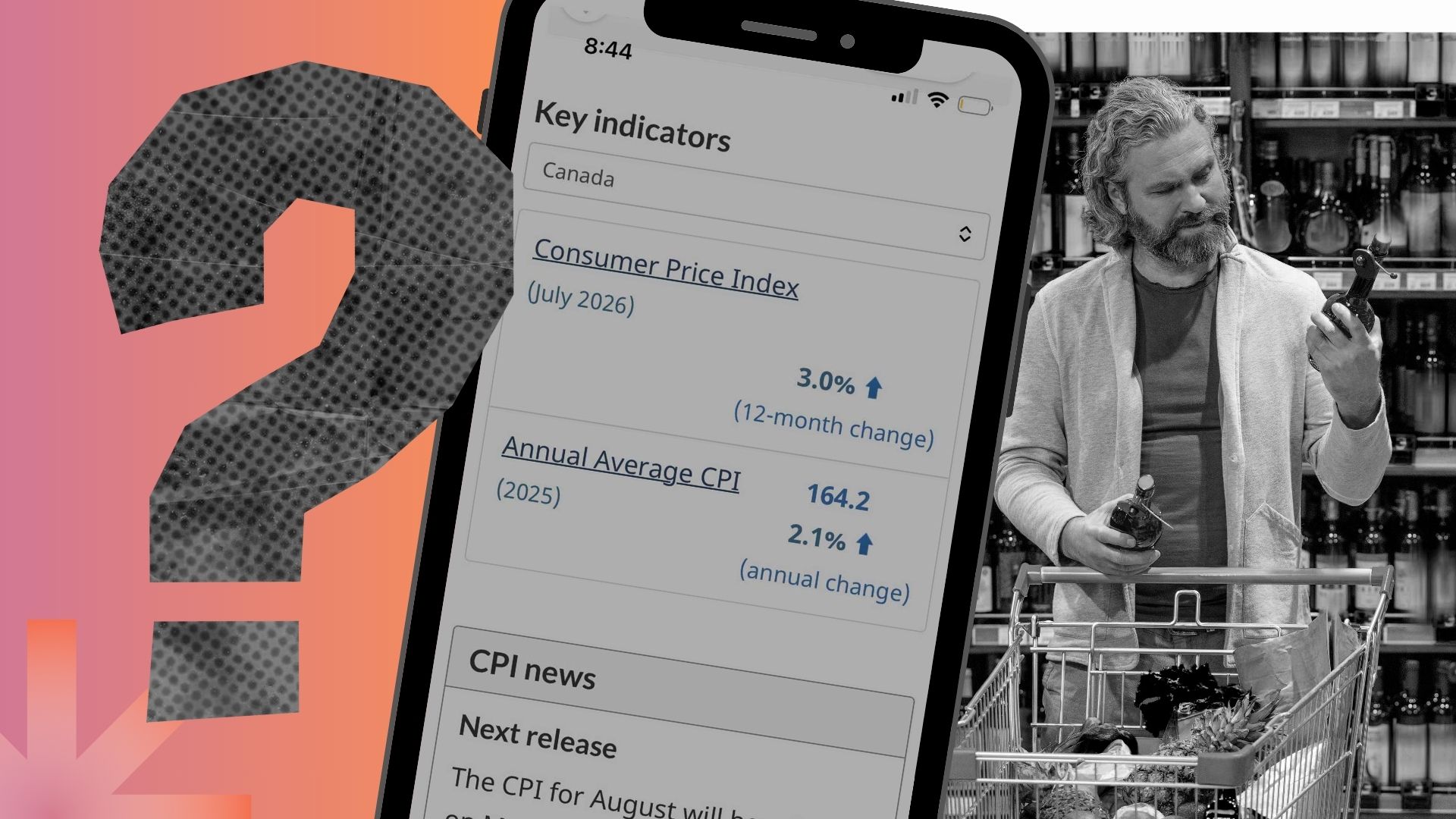
Inflation may be the economic force you notice most. And it can really hurt.
Inflation measures how fast prices are rising. When inflation spikes, your money buys less—from groceries to gas, to clothes and travel. (Read: Why fast food isn’t cheap in Canada anymore.)
If your wages don’t keep pace with inflation, your purchasing power shrinks, says Christopher Ragan, an associate professor of economics at McGill University. For example, if inflation rises by 4% and your pay only goes up by 2%, you’re effectively two percentage points worse off. You’ll feel the financial squeeze when buying pretty much anything.
For decades, inflation stayed low (around 1% to 2%). And many Canadians barely noticed it. That changed after the COVID-19 pandemic, when inflation surged, briefly hitting 8%. Suddenly, sticker shock was everywhere. “And we were reminded of how much we all hate inflation,” Ragan says.
GDP: The wealth of nations, and you
Talk of Canada’s Gross Domestic Product (GDP) may seem unimportant on an individual basis, but GDP has a subtle yet long-lasting impact on your quality of life.
GDP means the total value of goods and services produced in Canada. When GDP grows, employers are more likely to hire and offer raises, and governments collect more tax revenue to fund services. When GDP growth slows or falls, hiring freezes become more common, raises disappear and public budgets tighten.
GDP ÷ number of Canadians
That’s why “GDP per capita” matters as a broad measure of living standards. By dividing the country’s GDP (which represents the size of the economy) by the number of people, it gives an approximate sense of whether you’re better off on average.
Canada’s GDP per person is about $60,000. But if population growth outpaces economic growth, GDP per capita can fall. For example, GDP per capita fell by about 1% in 2024 versus 2023. That may seem like a small number, but over time if GDP per capita falls or growth remains sluggish, a country’s living standards start to decline. That can affect everything from average wages to how much money the government has available to provide services—and even life expectancy.
Over time, rising GDP per capita “means material living standards are improving,” Ragan says. On the other hand, a prolonged slump in GDP growth results in citizens who are less well off.
The stock market: When the forecast calls for gain
The daily swings of the stock market may seem unimportant to your everyday life, unless you’re Elon Musk. But they matter if you have an RRSP (registered retirement savings plan), TFSA (tax-free savings account), pension, mutual fund or other investments.
Canada’s main stock market is the Toronto Stock Exchange (TSX). While investors will pay attention to individual company stocks that they own, more broadly they track the S&P/TSX Composite Index, the country’s main stock market benchmark. This is what’s often mentioned in the news. It tracks the value of Canada’s largest public companies and offers a snapshot of how investors expect them to perform. When the index and markets rise, your investment accounts may grow faster. When they fall, you may need to save more or work longer before retiring.
When the stock market rises, that means companies are becoming more valuable, says McNeil. So investors are willing to pay more for a stock today than they were yesterday, and it can mean that investors are confident in the Canadian economy’s ability to grow. That sentiment can encourage companies to hire and invest, and consumers to spend.
Since “one person’s spending is someone else’s income,” that optimism can spread through the economy, creating jobs and lifting wages, he says.
The Canadian dollar: The value of your money
The value of the Canadian dollar can affect what you pay at the checkout, even here in Canada. That’s because many of the goods we buy are imported from other countries. Think: fruit and vegetables from the United States, coffee from Brazil and electronics (and potentially electric cars) from China.
The exchange rate is usually measured against the value of the U.S. dollar, which happens to be the currency of our largest trading partner. When the loonie weakens, it takes more Canadian dollars to buy the same number of imported products, says Ragan.
But there’s a flip side. “A weaker dollar can help exporters because Canadian-made products become cheaper for foreign buyers,” Ragan says. That can boost demand for Canadian jets, lumber, steel, and other goods that we export. If you work in exporting industries, a lower loonie can mean higher wages and greater job security—even if you still end up paying more for a coffee.
The unemployment rate: Security in the numbers?
The labour market is one of the most direct ways the economy can affect you. When unemployment is low and wages are rising, you have more leverage to change jobs, negotiate pay or negotiate for improved benefits. That security also makes it easier to spend because you feel more confident that you’ll continue to get a paycheque.
For many Canadians, the labour market matters more than GDP. GDP measures the economy as a whole, but the unemployment rate can seem more personal. “What matters most to people is whether they have a job or not,” McNeil says.
When unemployment rises or hiring slows, the impact spreads quickly. Even if you’re still working, you may pull back on spending if others around you are being laid off.
You are the economy
Trying to understand how all these factors fit together to affect you may seem like a lot. But Ragan suggests we shouldn’t think about the economy as something that “happens to us.” Rather, we should view ourselves as part of it.
With around 41 million Canadians, each of us represents one forty-0ne-millionth of the broader economy, he says. “It’s not like I’m sitting here and there’s an economy happening outside my window. I am one tiny, little share of the Canadian economy.”

Robert Gerlsbeck
Robert Gerlsbeck is a freelance editor and journalist. He is based in Kingston, Ont.


The Get is owned by Neo Financial Technologies Inc. and the content it produces is for informational purposes only. Any views and opinions expressed are those of the individual authors or The Get editorial team and do not necessarily reflect the official policy or position of Neo Financial Technologies Inc. or any of its partners or affiliates.
Nothing in this newsletter is intended to constitute professional financial, legal, or tax advice, and should not be the sole source for making any financial decisions. Past performance is not a guarantee of future results. Neo Financial Technologies Inc. does not endorse any third-party views referenced in this content. Always do your due diligence before deciding what to do with your money.
© 2026 Neo Financial Technologies Inc. All rights reserved.